Happy Saint Patrick's Day!

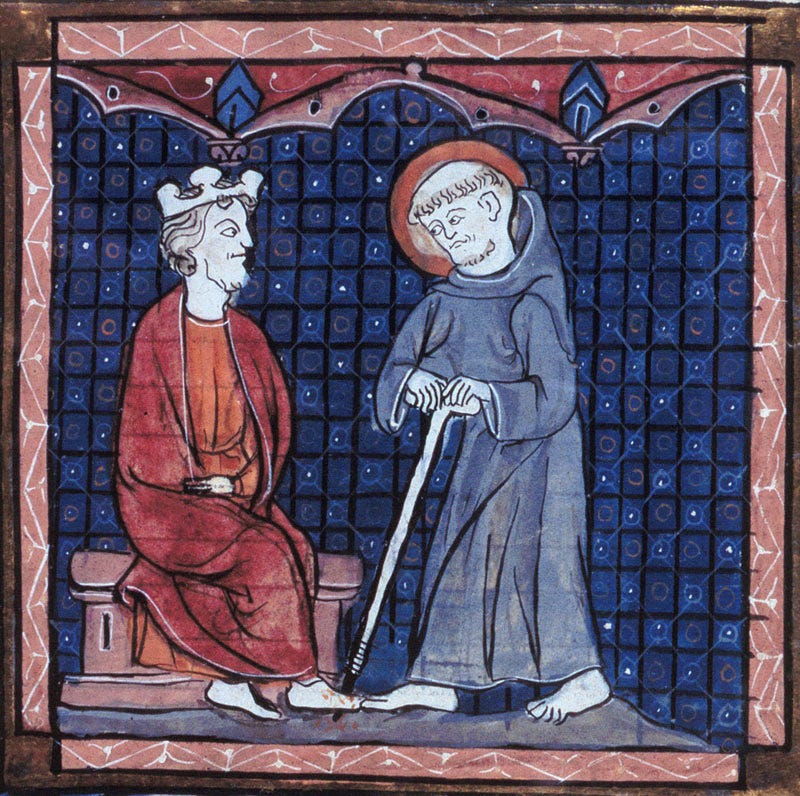
This is the oldest known picture of Saint Patrick, taken from the Legenda Aurea, published in France in the Thirteenth Century. There are no contemporary portraits or even descriptions of Patrick, and this picture was made about eight hundred years after he died, so we don’t really know what he looked like, but it’s probably as good a guess as any.
Patrick’s story is told in Thomas Cahill’s masterful work How the Irish Saved Civilization. He was born Patricius (we don’t know him by any other name), the scion of a Romanized British family. His dad was a tax collector and his grandfather was a priest, but young Patrick was not particularly religious. We don’t even know the exact year of his birth, but he must have come of age right around the time the Romans withdrew from Britain for good, leaving that island vulnerable to marauders from both the east and the west.
And the marauders came. Irish pirates kidnapped the youth and sold him into slavery. His new master put him to work as a shepherd, and for the next six years he endured a lonely and miserable state of servitude on that cold and rainy island. Stripped of all the comforts of his former middle-class existence, with no one else to turn to, he turned his gaze upwards, toward God.
After six years he made his escape. He was spirited away by sailors who agreed to return him to his family in anticipation of a lucrative reward. And he resumed his former comfortable existence, but one night in a dream he heard voices, begging him to return to the Emerald Isle.
Return he did, but it was not a straight-line path. First Patrick needed to resume his studies, interrupted by his captivity. He was ordained first as a priest, and then a bishop. Patrick probably was already in mid-life when he returned to the site of his former bondage, which at the time still was steeped in intertribal warfare, slavery, and human sacrifice.
He crisscrossed Ireland, preaching this message to the eager multitudes: Love one another, do onto others as you would have them do onto you. You don’t need human sacrifice anymore, because God has already sent his own son to die for us all. It is not our deaths, but our lives, that God wants.
A pivotal incident in Patrick’s life came when Coroticus, one of the many local warlords who had arisen in the power vacuum created by the departure of the Roman legions from Britain, descended upon Ireland and slaughtered thousands of Patrick’s followers, taking many more as slaves. Patrick sent a delegation of priests to Coroticus to negotiate their return. When this was unsuccessful, he wrote an open letter to British Christians, imploring them to excommunicate Coroticus until he agreed to return his captives.
In sadness and grief, shall I cry aloud. O most lovely and loving brethren whom I have begotten in Christ (I cannot number them), what shall I do for you? I am not worthy to come to the aid of either God or men. The wickedness of the wicked has prevailed against us. We are become as it were strangers. Can it be that they do not believe we have received on baptism or that we have one God and Father? Is it a shameful thing in their eyes that we have been born in Ireland?
We don’t know what happened to Coroticus. But we do know that by the time Patrick died, slavery in Ireland had ended, and the internecine wars had (for the most part) died down.
With those words – that we have been born in Ireland – Patrick made it clear that his identification with his chosen people was complete. But there is an even more important point here.
The greatness of Saint Patrick is beyond dispute. He was the first man in history to unequivocally denounce slavery.
After Patrick died, his followers established the first monasteries in Ireland, places of prayer, contemplation, and learning. Ireland would never be conquered by outsiders until the Seventeenth Century. Meanwhile, as western Europe was wracked by barbarians and libraries were burned, the Irish monks preserved the works of the ancients, pagan and Christian alike. Scholars came from as far away as Egypt and Armenia came to join them, bringing their knowledge as well as priceless manuscripts.
And the monks fanned out, establishing new monasteries first in Scotland, then in England, and finally all over Europe, ranging as far east as Kiev. The monasteries grew into great cities, such as Lumièges, Auxerre, Laon, Luxeill, Liège, Trier, Würzburg, Regensburg, Rheinlau, Reichenau, Vienna, Saint Gall, Bobbio, Fiesole, and Lucca. Without the efforts of these monks, probably all of Latin literature would have been lost forever.
And that is how the Irish saved civilization.
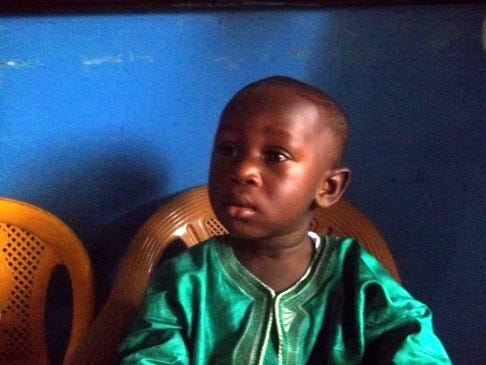
Here is a picture of my grand-nephew Patrick, taken on the occasion of his first birthday.
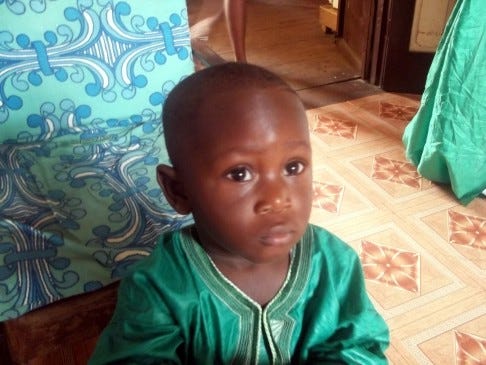
I believe I was named after my great-great-grandfather, Patrick Kedian. I don’t know this for sure, and it’s too late now to ask my mother.
But as I write this I have in front of me a copy of my grandmother’s baptismal certificate. She was born Mary Josephine Comber in Bekan Parish, County Mayo, Ireland, in 1892. The certificate lists her parents as Michael Comber and Catherine Kedian, and also listed as “Sponsor” is Patrick Kedian, whom I assume is the father of Catherine. An online search of the census records turned up one Patrick Kedian, born in County Mayo in 1841 and still living there at the time of the 1911 census, and no other Patrick Kedian who could possibly fill the bill. So I’m pretty sure this guy was my great-great-grandfather.
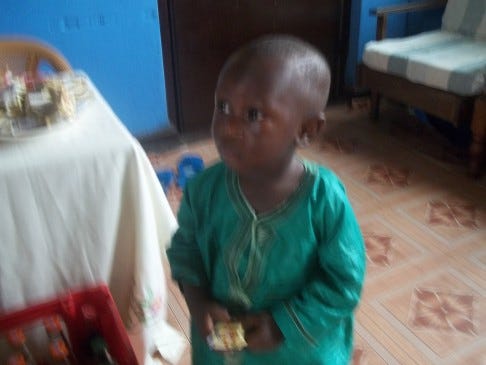
I wonder what he would have thought as a young man if he could have looked 150 years ahead into the future and seen a little African kid walking around with his name?
Saint Patrick portrait is in the public domain in its country of origin and other countries and areas where the copyright term is the author’s life plus 100 years or fewer.
All other photos by author.